Why Clients Won't Hire Coaches Who Can't Prove ROI (... and How to Fix It)
Feb 18, 2026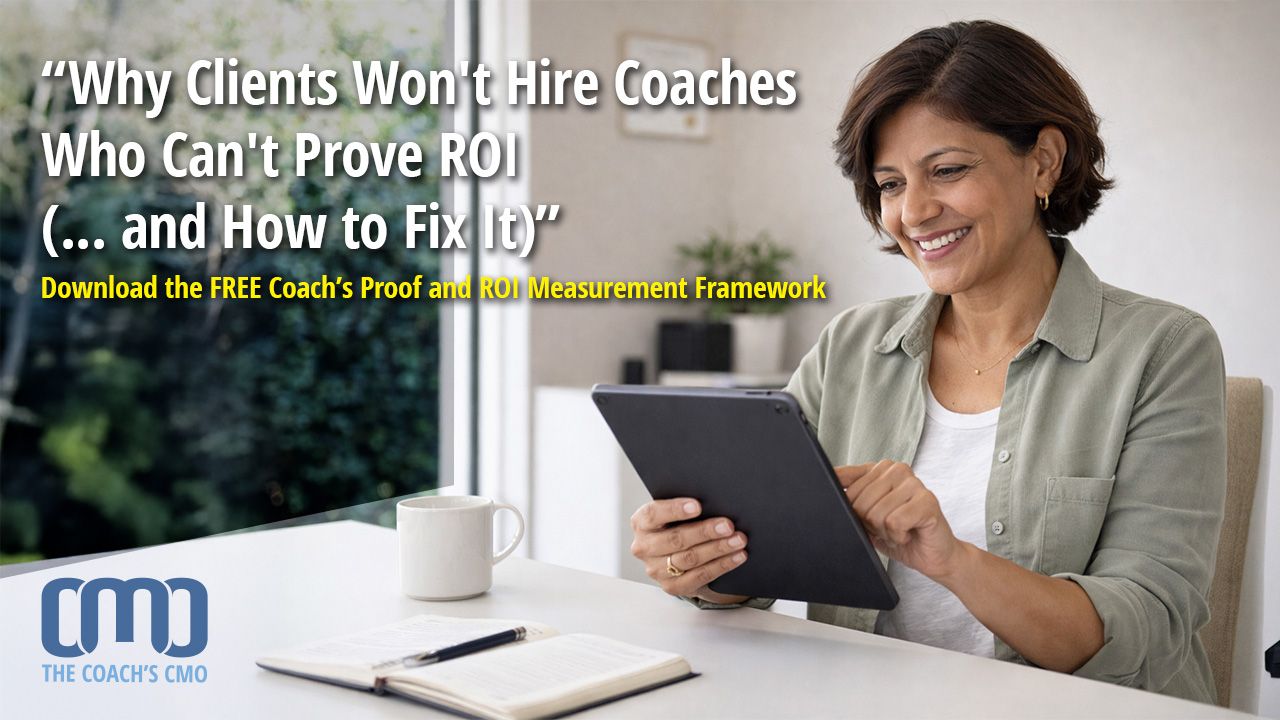
(Note: Scroll below to download The Coach's Proof and ROI Measurement Framework for FREE and get the complete outcome tracking system, proof library templates, ROI calculator worksheets, and 30-day implementation plan.)
You've built a successful coaching practice. You deliver real transformation. Clients achieve breakthrough results. Your LinkedIn testimonials are glowing. And yet, when you pitch a corporate contract or a premium individual client, something shifts.
They ask the question: "What's the ROI?"
And you pause.
You talk about leadership effectiveness. You share a compelling client story. You explain your methodology. But you can't put a number on it. You can't show them data. You can't demonstrate measurable outcomes in the language they need to justify the investment to their CFO or board.
That pause costs you the deal.
The Proof Gap That's Costing You Contracts
Here's what's changed in the coaching market: five years ago, a strong referral and a compelling story could close a $50K corporate contract. Today, procurement teams want benchmarks. HR leaders need board-ready ROI projections. L&D buyers are asked to justify every coaching dollar against measurable performance improvement.
This isn't about you being less qualified. It's about budgets being scrutinized more carefully.
When a VP of Talent is choosing between three equally credentialed coaches, the one who can demonstrate quantifiable outcomes wins. When an executive is considering a $25K personal coaching investment, they want to know what return to expect. When a corporate buyer has to defend coaching spend to finance, anecdotal evidence doesn't cut it anymore.
The gap isn't in your coaching quality. The gap is in your ability to translate transformation into metrics that decision-makers understand, trust, and can defend.
What Happens When You Can't Prove ROI
Without a proof operating system, three things happen that limit your business:
First, premium clients hesitate. They want coaching. They believe in transformation. But they can't justify the investment without concrete evidence. When your competitor shows up with case studies that include percentage improvements and dollar value calculations, you lose on credibility even if your coaching is superior.
Second, corporate opportunities stay closed. Enterprise buyers have procurement processes that require measurable outcomes. If you can't provide data on leadership effectiveness improvement, team performance gains, or retention impact, you don't get past the RFP stage. The corporate market stays out of reach.
Third, you leave pricing power on the table. When you can't demonstrate ROI, you compete on relationship and trust alone. That makes it harder to charge premium rates. The coaches who command $30K-$50K+ engagements aren't necessarily better coaches. They're better at proving value in business terms.
The cost isn't just lost deals. It's the strategic ceiling on your business model.
The Three Components Every Proof System Needs
Most coaches treat proof as an afterthought. A testimonial request at the end of an engagement. Maybe a case study if the client agrees. That reactive approach leaves money on the table.
Real proof systems are designed proactively. They start before the engagement begins and compound over time. Here's what the best coaches build:
Component 1: Outcome Tracking Framework
This is your system for capturing baseline metrics at the start, progress indicators throughout, and quantified results at the end. The key is choosing metrics that align with what buyers care about.
For executive coaching, that's often leadership effectiveness scores, team engagement levels, strategic time allocation, and 360 feedback improvement. For business coaching, it's revenue growth, profit margin, operational efficiency, and client acquisition cost. For sales coaching, it's close rates, deal size, pipeline velocity, and quota attainment.
You don't need to track everything. You need to track what corporate buyers and premium clients use to measure success.
Before each engagement, capture baseline data. During the engagement, document observable changes and milestone achievements. At the end, measure improvement and get permission to use the results as proof.
This gives you quantified outcomes you can reference in proposals, case studies, and sales conversations.
Component 2: Proof Library System
Once you're tracking outcomes, you need to organize proof in formats that close deals. A proof library isn't just a folder of testimonials. It's a strategic asset structured by industry, role, outcome type, and format.
Your library should include:
Full case studies with client context, challenge, approach, and quantified results. Keep these to 1-2 pages. Busy buyers scan for proof points, not narratives.
One-page case summaries for proposals and pitches. These are condensed versions designed to be consumed in 30 seconds.
Aggregated outcome data sheets that show patterns across multiple clients. Corporate buyers want to see consistency, not isolated wins. Show them that 78% of your clients achieve X outcome or that the average improvement is Y%.
Permission agreements so you can use client data confidently. Always get written authorization for what you can share and how you can share it.
Anonymous versions for confidential situations where clients can't be named but outcomes can be documented.
When a prospect asks "Do you have experience with leaders in healthcare?" you should be able to send a relevant case study within minutes. That responsiveness builds credibility faster than any pitch deck.
Component 3: ROI Calculator
This is where coaching outcomes become business justification. An ROI calculator translates transformation into dollar value that stakeholders can defend.
You don't need complex financial modeling. You need simple formulas that make the business case obvious.
Leadership time saved: If coaching helps a VP-level leader save 5 hours per week by delegating tactical work and focusing on strategy, what's that worth? At $300K annual comp, that's roughly $150/hour. Five hours weekly equals $37,500 in annual value. If the coaching investment is $18,000, the ROI is 108%.
Turnover prevented: If coaching keeps one key employee from leaving, what's the replacement cost? Recruiting, onboarding, and productivity ramp typically cost 150-200% of salary. Preventing one $120K employee departure creates $180K-$240K in value.
Sales performance improvement: If coaching improves a team's close rate from 18% to 25% on a $2M pipeline, that's $140K in incremental revenue. Against a $12K coaching investment, the ROI is 967%.
These calculations don't need to be precise. They need to be defensible and conservative. When the math is obvious, buyers say yes faster.
The 30-Day Plan to Install Your Proof System
You don't need months to build this infrastructure. Here's a realistic implementation plan:
Week 1: Choose metrics and build tracking. Identify 3-5 core metrics aligned with buyer priorities. Create baseline assessment questions. Build a simple tracking template.
Week 2: Document existing proof. List 5-10 past clients with strong outcomes. Reach out for permission to document results. Draft 2-3 case studies using a consistent template.
Week 3: Build your ROI calculator. Choose 2-3 ROI levers where you see consistent impact. Create simple formulas with conservative assumptions. Build a one-page calculator worksheet.
Week 4: Organize and deploy. Create your proof library folder structure. Build one-page summaries from full case studies. Use your ROI calculator in the next two discovery calls. Update your website or proposals with quantified proof.
Start with one metric this month. Document one case study with quantified results. Build one simple ROI calculator. That's enough to change how prospects see you.
Why This Matters More in 2026
The coaching market is projected to reach $6.4 billion globally by the end of this year. The number of certified coaches has more than doubled since 2019, reaching over 167,000 worldwide.
With this level of growth comes saturation. It's no longer enough to be a good coach. You need to prove you're effective in terms that corporate buyers and premium clients can defend to their stakeholders.
The coaches who thrive won't be the ones with the best stories. They'll be the ones with the best data.
Your transformation is real. Your impact is undeniable. Now make it measurable.
Ready to build your proof system?
Download The Coach's Proof and ROI Measurement Framework for FREE and get the complete outcome tracking system, proof library templates, ROI calculator worksheets, and 30-day implementation plan.
See the full suite of marketing strategy and execution services built exclusively for coaches who are ready to stop guessing and start growing with a system: www.thecoachscmo.com/services
Clarity & Positioning
Visibility & Authority
Engagement & Conversion
Growth & Optimization
P.s. If you're ready for clear strategy, smart systems, and creative marketing that works in the background while you focus on serving your clients... let’s talk.