Every Coach Has the Same AI Tools. That Is EXACTLY the Problem.
Apr 21, 2026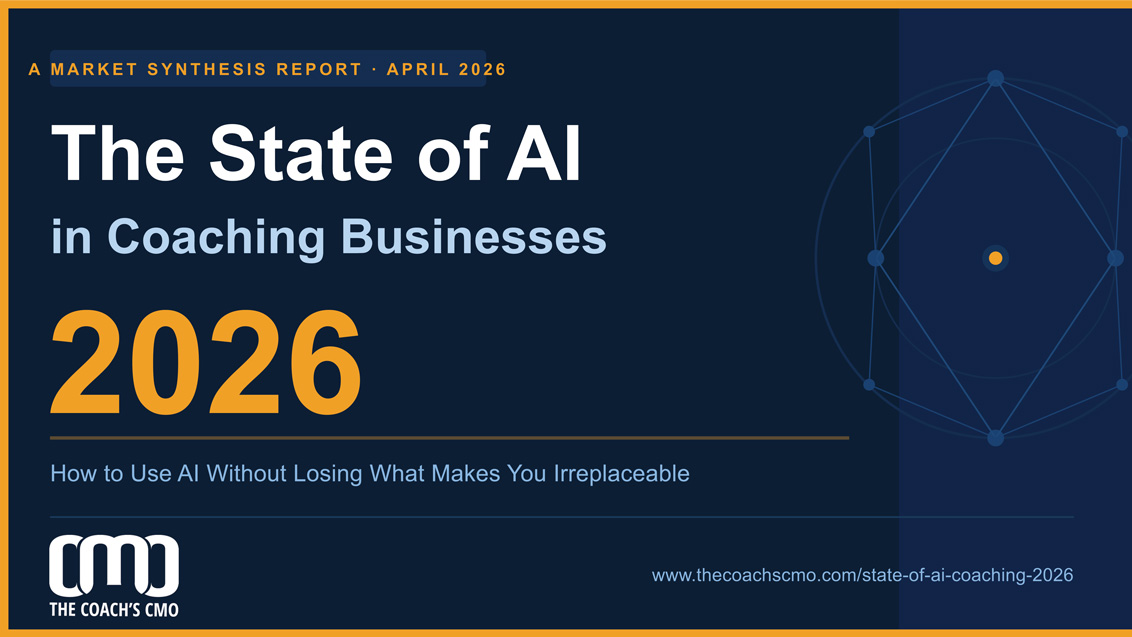
(Note: Scroll below to download The State of AI in Coaching Businesses 2026 for FREE and get the complete market synthesis report, niche-by-niche AI adoption profiles, the Six Growth Ceilings framework, and forward-looking recommendations for building an AI-powered coaching business that stays irreplaceable.)
The global coaching market will reach $5.8 billion in 2026. AI-specific coaching segments are growing at two to three times that rate. And the vast majority of coaches using AI right now are using it for the lowest-leverage application available to them.
That is not a technology problem. It is a strategy problem.
This is what The Coach's CMO's first market synthesis report on AI adoption inside coaching businesses reveals. And the findings are worth paying attention to ... because the gap between coaches who are generating real commercial returns from AI and coaches who are producing more content with no improvement in client acquisition is widening faster than most people in this profession realize.
The Adoption Rate Is Not the Problem
Most coaches are using at least one AI tool. The barrier is not access. The barrier is application.
Content creation is the dominant AI use case across every coaching niche. And content creation is the least commercially leveraged thing a coach can do with AI. More LinkedIn posts. More email copy. More graphics that look polished and sound generic. That is not a growth strategy. That is noise with better production values.
The commercial upside is in lead generation, conversion optimization, client retention systems, and revenue intelligence. Those are the applications that move the revenue needle. Those are also the applications that almost no coaches have prioritized.
The Authenticity Tension Is Real
Here is what no other report in this space is asking: what happens to the quality of your thinking when you let AI do the thinking first?
Behavioral economics has a name for this. The anchoring effect. When a coach uses AI as a starting point ... for session prep, for content, for client insight ... they anchor to the machine's output. The result is work that is consistently slightly less original, slightly less contextually precise, and slightly less distinctively theirs than what they would have produced from scratch.
Multiply that across thousands of coaches in the same niche and the coaching market ends up exactly where it is heading: flooded with AI-generated content that is undifferentiated, interchangeable, and increasingly easy to ignore.
The protection is not to avoid AI. It is to invert the workflow. Your thinking always leads. AI expands, refines, and executes. Never the reverse.
The Six Growth Ceilings AI Cannot Solve Alone
Every coaching business hits predictable growth ceilings. Client acquisition beyond referrals. Premium conversion. Scaling beyond calendar capacity. Authority and distribution. Client retention and expansion. Proof and ROI measurement.
AI is relevant to all six. But AI alone solves none of them.
Coaches who use AI for content without a clear acquisition architecture are producing content into a vacuum. Coaches who use AI to improve proposal language without pricing conviction will still discount under pressure. Coaches who use AI to create digital products without first deciding to build a leverage model are accelerating activity in the wrong direction.
Strategic clarity must precede AI adoption for leverage to work. This is the sequence most coaches have backwards.
Born in AI Versus Legacy Coaching Practices
The report documents a widening gap between legacy coaching organizations and Born in AI coaching firms ... practices founded after 2023 that built their delivery models around AI from the outset. Born in AI firms report productivity gains of 100% to 200%. They operate with dramatically leaner teams. And their structural advantage is something any solo or small-team coach can replicate ... by making AI a native part of the operating model rather than bolting it on to existing workflows.
What You’ll Learn Inside The State of AI in Coaching Businesses 2026:
✅ Why most coaches are using AI for the wrong things first ... and where the real commercial upside actually lives
✅ How each of the seven coaching niches is adopting AI differently ... and what that means for your competitive position right now
✅ The Six Growth Ceilings that AI cannot solve alone ... and what must be in place before AI delivers meaningful leverage
✅ What the Born in AI coaching model looks like ... and how solo coaches can capture the same structural advantage
✅ Why the authenticity concern is real, widely underestimated, and more nuanced than most coaches think
✅ How GEO and AEO are reshaping how coaches get found ... and why the window to act is 2026, not 2027
✅ The seven recommendations that apply regardless of your niche, your tech stack, or where you are in your AI journey
What’s Included:
-
The Full Market Synthesis Report A comprehensive analysis drawing on published coaching industry data, AI adoption research, third-party market reports, and The Coach's CMO's direct experience working inside coaching businesses across all seven niches. Not opinions. Not predictions. A grounded, commercially oriented synthesis of where the profession actually stands.
-
Niche-by-Niche AI Adoption Profiles Detailed profiles for all seven coaching niches ... executive, leadership, business, sales, health, career, and life ... covering current AI adoption rates, top use cases, key tools in active use, the human premium that remains irreplaceable, and the primary commercial opportunity in each segment. So you can see exactly where your niche stands and where the leverage is.
-
The Six Growth Ceilings Framework Applied to AI The Coach's CMO's proprietary framework mapping the six ceilings that prevent coaches from building scalable businesses ... client acquisition, premium conversion, scaling beyond the calendar, authority and distribution, client retention, and proof and ROI measurement ... against what AI can and cannot do for each one. So you stop using AI to amplify a strategy that was never going to work.
-
The Born in AI vs. Legacy Coaching Comparison A side-by-side analysis of how Born in AI coaching practices are achieving 100% to 200% productivity gains versus legacy counterparts ... and exactly what any coach can do right now to capture the same structural advantage without starting over.
-
The Authenticity Tension Analysis The section no other report in this space is addressing. A rigorous look at the anchoring effect, the disclosure question, and the one workflow inversion that protects your voice, your thinking, and your brand in an AI-saturated market.
-
The GEO and AEO Opportunity Map A clear breakdown of the five factors that determine whether AI-powered search recommends you or ignores you ... and why coaches who act in 2026 will have a compounding advantage over those who begin in 2027.
-
Seven Forward-Looking Recommendations Specific, sequenced, commercially grounded actions for coaches at every stage of AI adoption. Not a generic checklist. A prioritized framework built around where the highest-leverage opportunities are right now.
The Window to Get This Right Is Now
The coaching profession is 12 to 18 months behind enterprise marketing organizations in systematic AI adoption. That gap is closing faster than most coaches expect. GEO and AEO ... generative engine optimization and answer engine optimization, the new disciplines that determine whether coaches appear in AI-powered search ... are already active competitive differentiators. The coaches building citation-worthy content architecture now will have a compounding advantage over those who begin in 2027.
The coaches who build extraordinary businesses in the next three years are not the ones who use the most AI or produce the most content. They are the ones who use AI to do what they could never do alone ... and protect with discipline what makes their coaching irreplaceable.
The balance is the whole game in 2026.
(Download The State of AI in Coaching Businesses 2026. It is free and it will change how you think about where AI fits in your coaching business growth strategy.)
If I can support you or your organization in any way, I'd love to chat.
To your continued success and cheering you on!
- Scott