Corporate Does Not Hire the Best Coach. It Hires the One It Can Justify.
May 10, 2026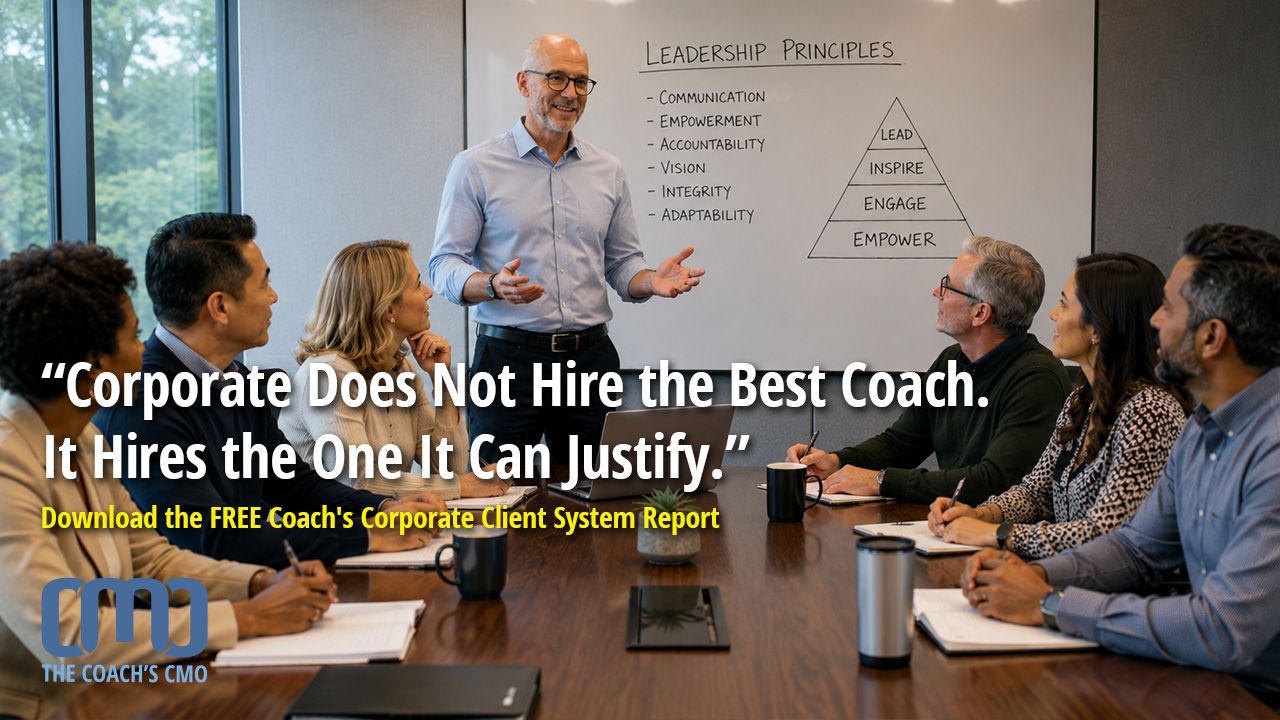
(Note: Scroll below to download The Coach’s Corporate Client System… a FREE 17-page strategic guide. You'll get the five-move B2B expansion system that closes the gap between the corporate results your coaching already produces and the corporate clients who are not hiring you yet ... without cold outreach that goes nowhere, consumer positioning that organizational buyers cannot evaluate, or waiting for the corporate market to discover you on its own.)
Most coaches assume the barrier to landing large corporate clients is experience or credentials. It is not. It is positioning. And more specifically, it is understanding how organizational buyers think ... which is fundamentally different from how individual clients think.
Here is the core distinction that changes everything.
Corporate buyers are not evaluating whether you are a good coach. They are evaluating whether hiring you is a safe decision. Their internal question is not "Do I like this person?" It is "If this engagement underperforms, how do I explain that to my leadership?"
That shift in perspective changes everything about how you need to show up.
Your Current Language is Built for the Wrong Buyer
Here is where most coaches lose corporate buyers before the conversation even begins.
Consumer coaching language sounds like this:
- Help leaders unlock their full potential
- Create meaningful personal transformation
- Build confidence and clarity from the inside out
Corporate coaching language sounds like this:
- Reduce time-to-performance for newly promoted senior leaders
- Improve cross-functional communication and lower leadership attrition
- Accelerate executive presence and decision-making in high-stakes environments
Same methodology. Completely different frame. One justifies a budget internally. The other does not.
You Are Probably Targeting the Wrong Person Inside the Company
The instinct is to go straight to the Chief People Officer or the VP of HR. But the person who actually puts coaching on the agenda inside most organizations is the internal champion ... the manager or HR business partner who directly experienced the problem you solve. Reaching the champion first is almost always the faster path to the economic buyer.
Inside most organizations, the coaching decision involves three distinct roles:
- The champion, who creates internal demand and builds the business case
- The economic buyer, who approves the budget and signs the agreement
- The user, who actually participates in the coaching
Most coaches only have an outreach strategy for one of those three. Build a plan for all of them.
The Coach Who Helps Them Say "Yes" Internally Wins the Engagement
Here is something most coaches never consider. The person who wants to hire you is rarely the person who can approve the budget. That means your champion ... the manager or HR business partner who believes in your work ... has to sell you internally before you ever get a formal conversation with the economic buyer.
Most coaches leave that person completely unsupported. They deliver a compelling discovery call, send a proposal, and then wait. What they should be doing is giving their champion the language, the framing, and the business case they need to walk into a budget conversation and win it.
This is what justification actually means in a corporate context. It is not about proving your credentials. It is about making it easy for the people who want to hire you to explain to the people who control the budget why this investment makes organizational sense.
Here is what that looks like in practice. When a client of yours improves their leadership presence and gets promoted, that is a personal transformation. When you frame it as a 40 percent reduction in time-to-effectiveness for a newly promoted senior leader, that is a line item someone can defend in a budget meeting. Same outcome. Completely different internal currency.
The organizational metrics that justify coaching investments most reliably are not complicated. They are the ones your clients are already experiencing. You simply have not translated them yet. Consider how you would reframe these:
- A client who communicates more clearly becomes: improved cross-functional alignment and reduced meeting overhead for senior leadership
- A client who manages conflict better becomes: measurable reduction in team attrition and HR escalation costs
- A client who makes decisions faster becomes: accelerated project timelines and reduced organizational drag at the leadership level
Your champion does not need a fifty-page ROI analysis. They need two or three outcome statements specific enough to survive a CFO's question and credible enough to justify a line item that typically ranges from $5,000 to $50,000 depending on scope and seniority.
The coaches who win corporate engagements consistently are not the ones who wait for buyers to figure this out on their own. They are the ones who hand their champion the business case on a plate ... and make saying yes internally as easy as saying yes in the discovery call.
Here is How to Start
If corporate clients are on your radar for 2026, here are four moves to make before you send a single outreach message.
-
Audit your LinkedIn headline and About section. Count how many words describe personal transformation versus measurable business outcomes. Rewrite toward outcomes first. This is the single highest-leverage change available to most coaches entering the B2B market.
-
Build one corporate case study. Take an existing client result and reframe it with organizational context: the business challenge, your specific approach, and the measurable outcome. One well-written case study will do more work than any volume of generic testimonials.
-
Restructure at least one offer into a scoped program with defined deliverables and outcome language. Corporate buyers do not purchase sessions. They purchase programs with milestones, clear deliverables, and professional contracting language. Organizational budgets for coaching at mid-market and enterprise companies range from $5,000 to $50,000 per engagement. Price accordingly.
-
Map your warm introduction network before you touch cold outreach. The first corporate client almost never comes from a cold LinkedIn message. It comes from a referral. Identify the five people in your existing network with direct access to your target buyers and have an explicit conversation about introductions.
I put all of this together into a five-move system called The Coach's Corporate Client System. It's a FREE 17-page strategic guide that covers the language shift, the targeting approach, the proof assets you need, the offer structure that fits organizational buyers, and the 90-day outreach system for coaches who are ready to make this transition with deliberate strategy rather than hopeful activity.
Get it at no cost here: https://www.thecoachscmo.com/coachs-corporate-client-system
If breaking into corporate coaching is on your list for 2026, that is your starting point.
Drop a comment below if this resonated. Curious what feels like the biggest gap between where you are now and your first corporate engagement.