
Coaches: What If You’re Fixing the Wrong Marketing Problem?
Oct 25, 2026
Before adding another channel, tool, or task, identify what’s actually keeping the right prospects from becoming clients.
(Scroll down to take the free Coaching Growth Scorecard™ diagnostic. Identify whether your biggest obstacle is helping the right prospects find you, trust your expertise, or choose your coaching… and get three practical actions to prioritize this month.)
What I’m hearing from my coaching clients is that deciding what to do next can feel harder than doing the work.
There’s always another recommendation. Post more on LinkedIn. Launch a newsletter. Redo the website. Build a lead magnet. Try a live webinar.
Each sounds reasonable. Stack them up, and you’ve got a second job.
And the question underneath all that activity stays unanswered:
What is actually stopping more of the right prospects from becoming clients?
Until you can answer that, a longer list can spread your attention across problems you don’t have… while the one that matters most goes untouched.
Find where the decision breaks down
Prospects need to find you, develop confidence in your expertise, and decide your coaching is worth the commitment (and investment).
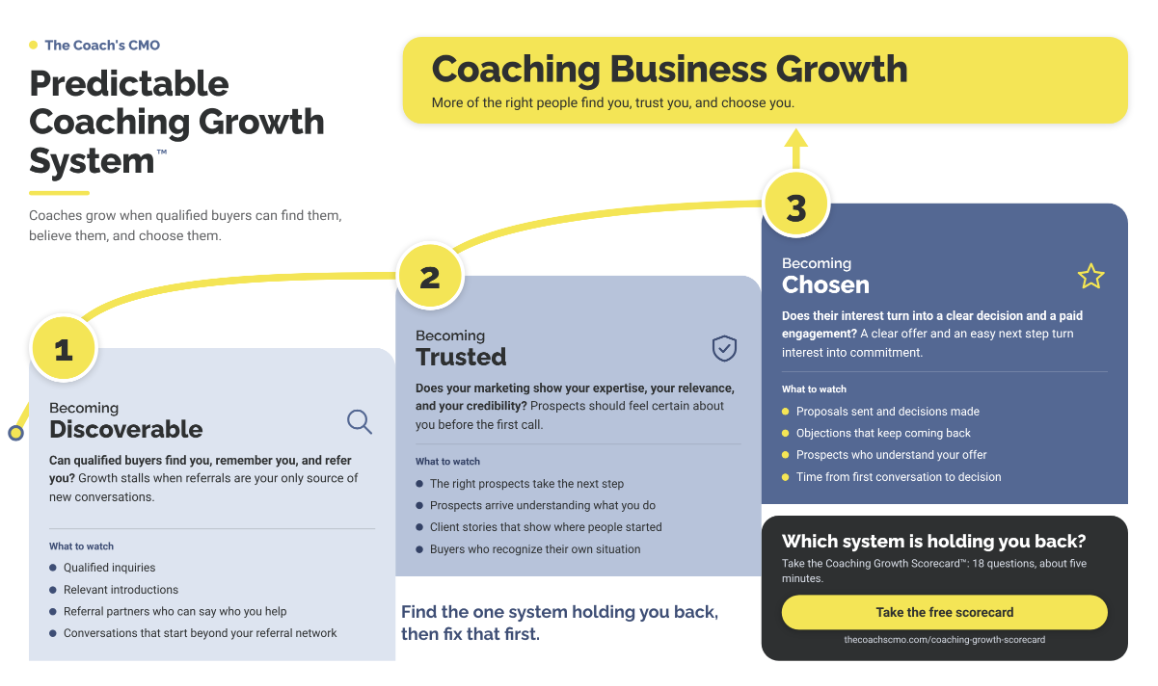
I organize those requirements into three connected systems that make up the Predictable Coaching Growth System™:
-
Discoverable: Can qualified buyers find you, remember you, and refer you?
-
Trusted: Does your marketing demonstrate your expertise, relevance, and credibility?
-
Chosen: Does their interest turn into a clear decision and a paid engagement?
The three affect each other. They don’t need equal attention at the same time.
 If qualified prospects visit your website but can’t recognize their situation in your messaging, more traffic puts more people in front of the same uncertainty.
That’s why priority matters.
What this looks like in practice
Picture an established executive coach with a respected corporate background, regular LinkedIn activity, and a website promising “leadership transformation.”
People engage with her posts. Former colleagues send introductions. But few prospects request a conversation.
Her first instinct is to publish more.
Now examine what happens after someone finds her. The website lists broad benefits. Testimonials praise her warmth and insight without explaining the client’s starting situation. The offer leaves buyers guessing what the work involves.
Those are signs of a trust gap worth investigating.
Her better move may be to build around one recognizable buying situation: a relevant client story, a clearer explanation of her coaching, and an appropriate invitation to talk.
Now the work on her calendar has a reason to be there.
Here’s how to make that call in your own business.
1. Trace your last five qualified opportunities
Where did each person come from? What did they review? What did they ask? Where did things stall?
Include people who didn’t hire you. Their hesitation can reveal what your strongest referrals never needed explained.
Look for repeated friction. One conversation isn’t a pattern.
2. Separate symptoms from causes
“Not enough clients” describes an outcome. It doesn’t identify the cause.
Perhaps too few qualified people encounter your business. Perhaps they can’t see why your expertise matters to their situation. Perhaps they’re interested but uncertain about the offer.
Write down your best explanation and the evidence behind it. Treat it as a working diagnosis you can revise.
3. Choose one priority for the next month
Make it specific enough to guide decisions.
“Improve my marketing” can’t tell you which task deserves attention first.
“Help referred prospects recognize when my coaching is relevant” can. That might lead to a focused website section, a stronger client example, and a resource addressing the same situation.
Those activities support one clear objective.
4. Define what progress would look like
Pick a measure close to the problem.
-
For Discoverable, watch qualified inquiries and relevant introductions.
-
For Trusted, examine whether appropriate prospects take the next step and arrive understanding your work.
-
For Chosen, track proposals, decisions, and recurring objections.
-
Likes alone won’t tell you whether the obstacle is changing.
5. Keep a “later” list
Maintain essential visibility and follow-up while directing improvement work toward your chosen priority.
Put other ideas on a list you can revisit without treating each as an obligation today.
At the end of the month, review the evidence. Continue, adjust, or choose the next constraint.
Which growth system deserves your attention first?
Take the free Coaching Growth Scorecard™ diagnostic. Answer 18 questions in about five minutes to identify your primary Discoverable, Trusted, or Chosen constraint… and receive a personalized growth briefing with three practical actions to prioritize this month.
Enjoy!

P.s. Get practical help with your coaching business growth and marketing. Leverage our free library of 34 self-assessments, guides, playbooks, blueprints, and systems specifically for coaches: www.thecoachscmo.com/resources.