
Your Coaching Message Explains What You Do. Does It Show Why It Matters Right Now?
Oct 06, 2026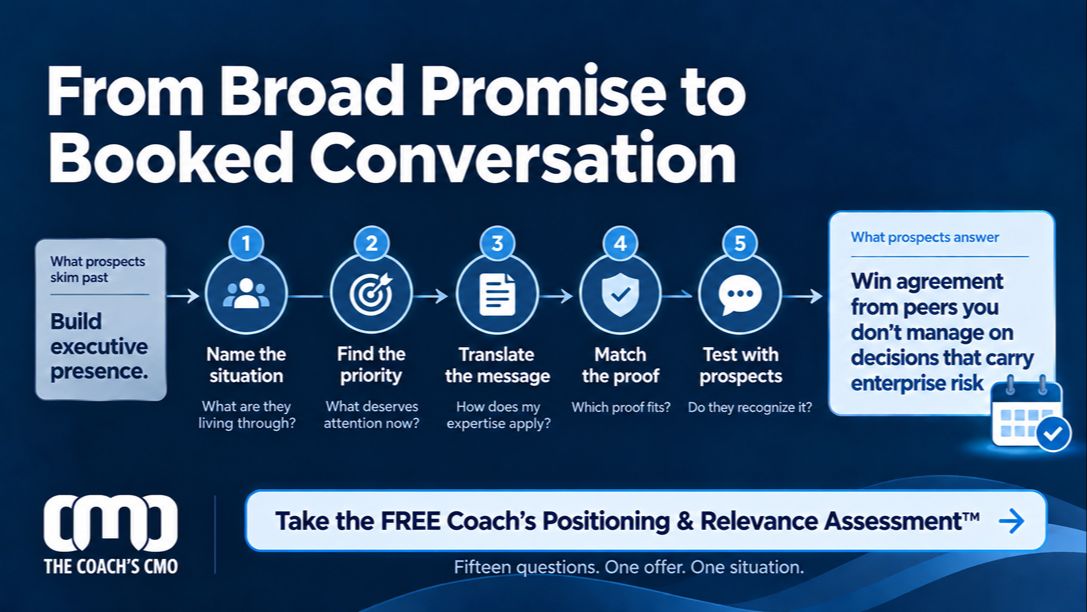
(Scroll below to take the FREE Coach’s Positioning & Relevance Assessment™ to determine if your coaching messages connect to the situation your prospects are facing right now.)
How established coaches connect proven expertise to the situations prospective clients are facing right now
You have a clear niche, strong credentials, and a methodology that works. Unfortunately, your messages can still miss the situation your next client needs help navigating right now.
Your website says you help executives become confident leaders. The executive reading it just inherited a bigger role and needs peers she doesn’t manage to support a consequential decision.
Confidence may matter. But the decision is what brought her looking for help. Does your message make that connection?
The gap can show up as polite interest, unanswered inquiries, or conversations that never develop. Before blaming visibility, examine what your positioning asks prospects to figure out for themselves.
Relevance is the beginning. Priority is the next question.
Karen Cappello, MCC, makes a useful distinction between relevance and readiness. Recognizing that coaching applies to you doesn’t automatically make it a priority.
Established coaches often anchor their positioning on enduring outcomes: stronger leadership, better teams, business growth. Those outcomes still matter. But the circumstances that make someone seek help can change.
A promotion expands accountability. A reorganization changes relationships. Growth exposes decisions that still depend on the founder.
When your message stays broad, prospective clients have to connect your promise to those circumstances themselves. Some will. Others will see an interesting service without recognizing a current reason to explore it.
More visibility can bring more people to that same unresolved connection.
Three situations. Three clearer openings.
Executive coaching: A functional leader takes on enterprise responsibility.
Before: “Build executive presence.”
After: “Step into enterprise leadership with the influence to align peers you don’t manage.”
The revised opening connects an established coaching outcome to the challenge created by broader responsibility.
Leadership coaching: A reorganization combines two leadership teams.
Before: “Create high-performing teams.”
After: “Bring two newly combined leadership teams into agreement on priorities, decisions, and accountability.”
The situation gives the promise a practical context. A sponsor can understand which organizational problem the engagement addresses.
Business coaching: An owner hires managers, but every important decision still returns to her.
Before: “Grow with confidence.”
After: “Build management accountability so decisions move forward without every issue coming back to you.”
The opening names a recognizable obstacle and the progress the owner wants. Your delivery and evidence must support the promise.
Preserve the expertise. Reconsider its application.
-
Start with one existing offer and one situation your ideal clients actually experience. What changed? What became harder? What deserves attention? Which part of your expertise helps?
-
Then examine your current assets. A relevant case story may already exist. A familiar framework may need a clearer application. Some proof may establish credibility without demonstrating experience in this particular situation.
-
Test the revised opening with three people who have experienced it. Ask what feels accurate, what matters most, and what sounds assumed. Their corrections are more useful than compliments.
-
A trigger event is a clue, not proof of demand. Budget, trust, fit, and approval still influence whether a prospect moves forward.
-
If they don’t recognize the problem or consider it important, revisit your assumptions before investing in wider distribution.
That review should leave you with a practical decision: preserve the message, adapt its opening, or investigate a different situation. Use what people confirm to guide your next marketing investment, with a clear reason for the change you are making.
Find what to preserve, adapt, and test
I’ve developed the free Coach’s Positioning & Relevance Assessment™ to help coaches review how well your positioning connects one existing offer to one current client situation.
15 questions cover situation clarity, changed priorities, positioning fit, existing asset relevance, and message validation. Your results highlight three priorities, with practical advice and examples for executive, leadership, and business coaches. You also receive a Situation-to-Message Brief and a focused 90-day testing roadmap.
Help prospective clients recognize where your expertise belongs in the decisions they need to make now.
Enjoy!

P.s. Get practical help with your coaching business growth and marketing. Leverage our free library of 33 self-assessments, guides, playbooks, blueprints, and systems specifically for coaches: www.thecoachscmo.com/resources.